
What a Business Development Manager Actually Does
A lot of job advertisements for business development managers are unclear. They give you a list of 20 duties, mix in marketing, sales, and strategy work, and left you wondering what the job actually entails.
Most individuals read more job advertisements in an attempt to figure it out. That is not helpful. Job advertisements are frequently replicated from one another.
The BDM position is explained in detail in this article. what it includes. What it doesn’t. The definition of success. You’ll have a clear image at the end, whether you’re hiring for the position, applying for it, or simply trying to figure out what your BD manager is meant to be doing.
Quick Answer
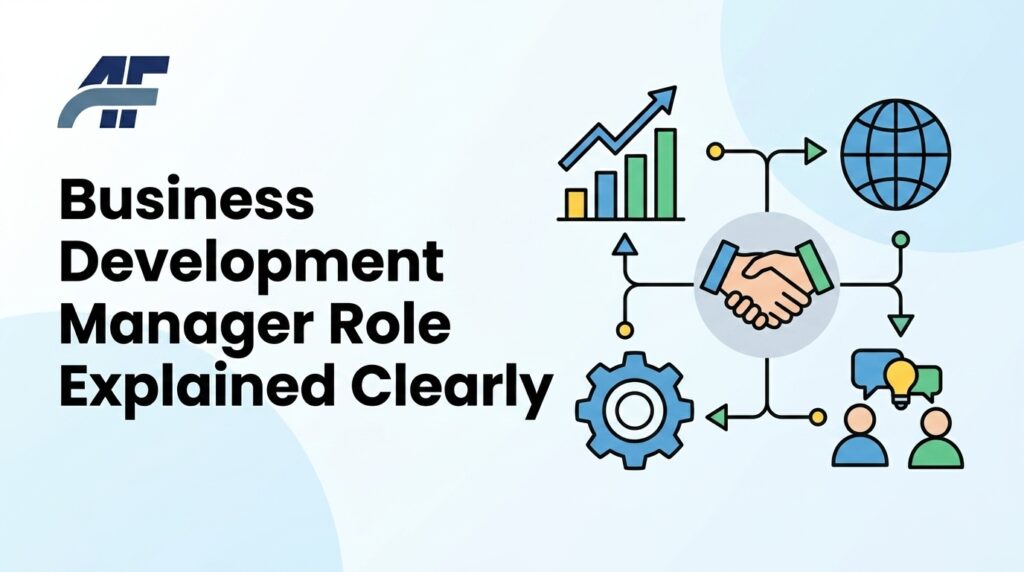
Quick Answer: A business development manager finds new ways for a company to grow. That means identifying new clients, building partnerships, and opening new markets. The role sits between sales and strategy. Most BDMs spend their time on prospecting, relationship building, and deal structuring, not day-to-day sales or marketing execution.
What Are the Core Business Development Manager Responsibilities?
Why It Occurs
Because business development duties can overlap with sales, account management, and product planning, many are confused about this position. There is a real overlap. However, the main emphasis is different.
The Fix
Here’s what a BD manager is actually responsible for:
- Finding new revenue opportunities. This means identifying markets, industries, or client segments the company isn’t currently serving. It’s not about managing existing accounts. It’s about opening new ones.
- Building and managing partnerships. BDMs often negotiate deals with other businesses – distribution partners, resellers, integration partners, or joint venture arrangements.
- Moving early-stage deals forward. A BDM takes a lead from “interested” to “ready to buy,” then hands it off to sales or closes it directly depending on the company structure.
- Reporting on pipeline and opportunity progress. BDMs track which opportunities are active, what stage they’re at, and what the likely revenue outcome is.
[RELATED POST: https://websoftocean.com/]
The outcome
The job description makes sense after you comprehend these four categories. In a BDM posting, everything else is often a subset of one of these.
How Is a BDM Different from a Sales Manager?
Why It Occurs
The most frequent source of misunderstanding is this. Employers use the titles interchangeably, which leads to serious issues with hiring and role management.
The Fix
Here’s a simple way to tell them apart:
| Focus Area | Business Development Manager | Sales Manager |
|---|---|---|
| Primary goal | Open new markets and partnerships | Hit revenue targets from existing pipeline |
| Client stage | New prospects and early conversations | Leads that are ready to buy |
| Deal type | Complex, longer-cycle, strategic | Shorter cycle, higher volume |
| Reporting | Pipeline potential and new opportunities | Closed revenue and quota attainment |
A BD manager job role is about building the pipeline and finding new doors. A sales manager is about walking through the doors that already exist.
The outcome
When these jobs are clearly defined, everyone is aware of their responsibilities. Unlike sales managers, BDMs are not evaluated on closed revenue. They are evaluated based on collaborations formed and new possibilities generated.
Common Mistakes:
- Hiring a BDM and then managing them like a sales rep.
- Setting quota targets for a BDM based on closed deals from the first month, when most BDM deals take 3 to 6 months to close.
What Does a BDM Job Description Usually Get Wrong?
Why It Occurs
The majority of BDM job duties specified in job advertisements are copied from other advertising by HR staff. The end product is a combination of duties from three distinct jobs. This draws in the incorrect applicants and makes the hiring process unsuccessful.
The Fix
- Remove tasks that belong to sales ops, like updating CRM records or managing invoices. That’s not a BDM task.
- Remove tasks that belong to marketing, like writing content or running campaigns. A BDM uses those assets. They don’t create them.
- Keep focus on three things: prospecting new opportunities, structuring deals, and building external relationships.
- Set clear success metrics. Good ones include: number of new partnership agreements signed, number of qualified opportunities added to pipeline per quarter, and average deal size from BDM-sourced leads.
[INTERNAL LINK: https://ahmadflow.com/]
The outcome
Candidates who genuinely possess the necessary skills are drawn to positions with a clearer job description. Additionally, it sets clear expectations for the new recruit right away.
Pro Tip: Cut your BDM job description in half if it contains more than ten bullet points. Better candidates are not drawn to longer lists. They simply perplex people.
What Skills Does a Strong Business Development Manager Need?
Why It Occurs
BD managers are frequently selected based on their personality; they are self-assured, have strong communication skills, and seem to be effective at fostering relationships. That is insufficient. Certain abilities are needed for the position, which aren’t usually evident during an interview.
The Fix
Here are the skills that actually matter in a business development manager role:
- Prospecting discipline. The ability to consistently identify, research, and approach new potential clients or partners, without being told to. Self-starters only.
- Negotiation skills. Not aggressive deal-pushing. The ability to structure a deal that works for both sides and move it to agreement.
- Commercial awareness. A BDM needs to understand margins, pricing logic, and what makes a deal actually profitable – not just signed.
- Communication across levels. BDMs talk to junior buyers and senior executives. They need to adjust their communication style without losing the message.
- Pipeline discipline. Keeping accurate notes, tracking deal stages, and forecasting honestly. A BDM who can’t manage their pipeline is a BDM you can’t trust to forecast from.
The outcome
You get a BDM who works without continual supervision when you employ for these particular talents. That’s the objective.
How Do You Measure a BDM’s Performance?
Why It Occurs
This is where the BDM role fails for the majority of businesses. BDMs are either not measured at all or are measured in the same manner as salesmen (closed revenue). Neither is effective.
The Fix
Use a tiered approach to measuring BDM performance:
- Activity metrics (weekly). How many new prospects contacted? How many meetings booked? How many partnership conversations started? These show early effort.
- Pipeline metrics (monthly). How many new qualified opportunities added? What’s the estimated value? Are deals moving forward or stalling?
- Outcome metrics (quarterly). How many new partnerships signed? How much revenue came from BDM-sourced deals? What’s the average deal size compared to last quarter?
Set targets for each tier. Review them in your monthly one-on-one. If activity is high but pipeline isn’t growing, the quality of prospects needs work. If pipeline is growing but deals aren’t closing, the handoff to sales is broken.
The outcome
Before you’re asking why sales hasn’t increased after three quarters, you have a clear picture of what is and isn’t working.
Be advised not to evaluate a BDM based just on closed income within the first ninety days. They won’t conclude the majority of their early agreements until month four or later. Short-term activity and pipeline measurements.
[RELATED POST: https://ahmadflow.com/ ]
FAQ
What does a business development manager do day to day?
A business development manager spends most days prospecting new clients, following up on active deals, and building relationships with potential partners. They attend meetings, send proposals, and update their pipeline. The exact split depends on the company, but most BDMs focus 60% on outreach and relationship work and 40% on deal structuring and internal coordination.
What’s the difference between business development and sales?
Business development focuses on finding new markets, partners, and opportunities that don’t yet exist in the pipeline. Sales focuses on closing deals that are already in progress. A BDM creates the opportunity. A sales manager or account executive closes it. In smaller companies, one person does both, but the tasks are still different.
What are the most important BDM job responsibilities?
The most important responsibilities are prospecting new clients, building partnerships, and moving early-stage deals forward. Everything else supports those three. A BDM who can’t prospect consistently or structure a deal won’t succeed regardless of how well they do the smaller tasks on the job description.
How do I know if my business development manager is performing well?
Track three things: activity (outreach volume), pipeline growth (new qualified opportunities per month), and outcomes (partnerships signed and revenue from BDM-sourced deals). If all three are growing steadily, performance is on track. If any one of them is consistently flat, that’s the area to investigate and fix.
What qualifications does a business development manager need?
Most BDM roles don’t require a specific degree. Employers usually want 3 to 5 years of experience in a sales, partnerships, or client-facing role. Strong communication skills, commercial thinking, and a proven track record of opening new accounts matter more than formal qualifications. Industry knowledge is often listed as a requirement and is worth taking seriously.
Why do so many BDM hires fail within the first year?
Most BDM hires fail because expectations weren’t set clearly at the start. The job description was too broad, the success metrics weren’t defined, or the company expected closed revenue before the BDM had time to build a pipeline. A clear 90-day plan with realistic activity targets fixes most of this before the hire even starts.
The BDM Role Works When It’s Set Up Correctly
The majority of the time, setup issues-rather than human issues-cause the business development manager position to fail. The new hire spends the first three months speculating on what success looks like, the job description is ambiguous, and the KPIs are taken from sales.
Here, the fixes are simple. Clearly define the position. Keep it apart from sales management. Employ for commercial awareness and prospecting discipline. Prior to measuring closed revenue, measure pipeline and activity.