Introduction
Remote Software Engineer Jobs
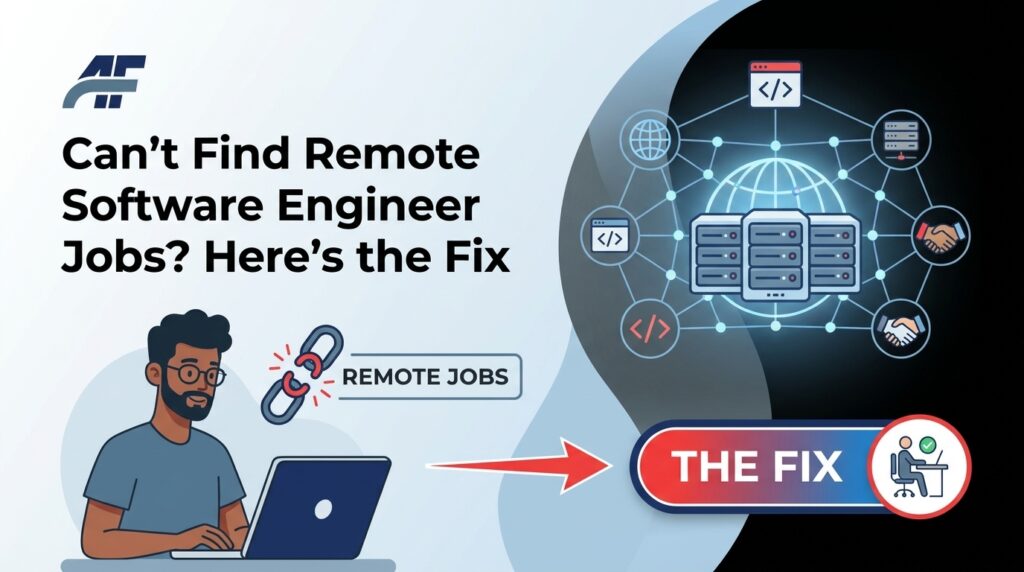
It seems more difficult than it should to find remote work for software engineers. You apply to several job advertisements. You may receive a brief email rejection or no response at all. It’s annoying, particularly if you are qualified for the position.
Applying for extra employment is how most individuals attempt to address this. That is ineffective. Usually, your skill level is not the issue. It has to do with where you look, how you search, and how your application is seen.
This article explains what’s truly wrong and provides a step-by-step solution.
A Brief Response
Because most people use resumes designed for office employment and seek in the incorrect areas, remote software engineer positions are difficult to locate. To address it, look for remote-specific job sites, modify your CV to reflect remote employment, and create a portfolio that demonstrates your capacity for independent work. When they stop applying in bulk and start focusing on the appropriate companies, the majority of people experience success.
Why You’re Not Getting Replies to Remote Job Applications
Why It Happens
Most job seekers use general job boards like Indeed or LinkedIn. These sites list thousands of jobs, but many “remote” listings are fake, outdated, or already filled. Your application gets buried under hundreds of others.
The Fix
- Use remote-specific job boards. Sites built only for remote work, such as We Work Remotely, Remote OK, and Himalayas, have fewer but more real listings.
- Search for remote developer jobs and remote programming jobs using these exact terms, not just “developer jobs.”
- Check the post date. Apply only to jobs posted within the last 7 days. Older listings often get hundreds of applicants already.
- Set up job alerts on 3 to 4 remote-focused sites so new listings reach you fast.
Result
You spend less time applying and get more replies, because you’re competing with fewer people for real jobs.
Common Mistakes:
- Applying to jobs that are 30+ days old.
- Only using one job board.
[INTERNAL LINK: https://ahmadflow.com/ ]
Why Your Resume Gets Rejected for Remote Roles
Why It Occurs
A lot of resumes are created for office-based positions. They emphasize working “on-site” or being a “team player.” Managers of remote recruiting look for many cues, including as effective communication and self-management.
The Fix
- Add a line near the top that states you have remote work experience or are set up to work remotely full-time.
- List tools you know for remote work, like Slack, Zoom, Jira, and GitHub.
- Show results, not just tasks. Instead of “wrote code for app,” say “built a feature that cut load time by 30%.”
- Keep your resume to one page. Hiring managers for remote software developer jobs often skim fast.
The outcome
More of your applications advance to the interview stage because your resume reflects what remote hiring managers genuinely look for.
Pro Tip: Put a link to your portfolio or GitHub account directly beneath your name. Before reading anything else, remote hiring managers review this.
Why “Full Stack” Roles Are Extra Competitive
Why It Happens:
Remote job posts for full stack developers draw more candidates than those for backend-only or frontend-only positions. Employers prefer full stack recruits since they require fewer workers to do more work, which means you will face greater competition.
The Fix
- Pick 2 to 3 core skills to highlight instead of listing every framework you’ve touched.
- Build one strong project that shows both frontend and backend work together, not two separate small ones.
- Apply to smaller companies and startups first. They often need full stack help more urgently than large companies.
Result
You stand out with depth instead of blending in with a long list of skills everyone else also has.
| Approach | Pros | Cons |
|---|---|---|
| Apply to large companies | Better pay, more structure | Slower process, high competition |
| Apply to startups | Faster replies, more responsibility | Less job security |
| Freelance first | Builds remote track record | Income is less steady |
Why You Never Hear Back After the Interview
Why It Occurs
Since employers cannot observe how you operate in person, remote interviews frequently involve a technical exam or a communication check. Many applicants neglect to practice clear, remote-style communication in favor of preparing exclusively for code problems.
The Fix
- Practice explaining your code out loud, not just writing it. Remote interviewers judge how well you explain your thinking.
- Test your camera, mic, and internet before every interview. Technical issues create a bad first impression.
- Ask about their remote work setup, like time zones and meeting schedule. This shows you’re serious about working remotely long-term.
Result
You come across as remote-ready, not just technically skilled, which is what most companies are actually screening for.
Why Time Zones Are Costing You Job Offers
Why It Occurs
When recruiting remote software developers, many businesses require overlapping hours with their main staff. Even a strong candidate is passed over if your time zone is different.
The Fix
- Check the job post for required overlap hours before applying. Some list this clearly, others don’t.
- If no time zone is listed, ask in your application or cover letter.
- Look for companies that are fully asynchronous. These care less about your exact hours and more about your output.
Result
You stop wasting time on roles that were never a time zone match, and you focus on jobs you can realistically get.
FAQ
Why is my remote job search taking so long?
Most remote job searches take longer because people apply broadly instead of targeting the right platforms. Use remote-specific job boards, apply within 7 days of posting, and tailor each resume. This alone cuts search time significantly compared to mass-applying on general job sites.
How do I fix a resume that isn’t getting responses?
Add remote work experience or readiness near the top of your resume. Include tools like Slack, Zoom, and GitHub. Show measurable results instead of task lists. Keep it to one page so hiring managers can scan it fast.
What causes rejection after a remote interview?
Rejections often happen because candidates prepare only for technical questions and skip communication practice. Remote interviewers judge how clearly you explain your work. Practice speaking through your code and test your equipment before every call.
Where can I find legitimate remote software engineer jobs?
Legitimate listings are easier to find on remote-only job boards like We Work Remotely, Remote OK, and Himalayas. General job boards often have outdated or fake remote listings mixed in with real ones.
Do I need to know every framework to get a full stack developer job remote?
No. Employers prefer depth in 2 to 3 core skills over a long list of frameworks you barely know. A strong project showing real full stack work is more convincing than a long skills list.
Does time zone really affect remote job offers?
Yes. Many companies need overlap hours with their team for meetings and collaboration. Check the job post for required hours, or look for asynchronous companies that focus on output instead of live hours.
In conclusion
Once you know where to seek and how to market yourself, it is possible to find remote software engineer employment. Using remote-specific job sites, revising your CV for remote employment, and customizing your search to organizations in your time zone are the three largest advantages.
Start today by selecting one remote employment board that you haven’t yet utilized and submitting an application to one of this week’s postings. This kind of small, targeted action yields tangible effects more quickly than submitting a hundred generic applications.