Introduction
You started an FSI blog to share real financial knowledge. Weeks later, you’re staring at a traffic graph that barely moves. Sound familiar?
The majority point the finger at the writing. Seldom is that the true problem. The true problem is typically one of a few solvable issues: a content strategy that never existed in the first place, an excessive amount of jargon, a lack of a clear reader, or inadequate trust signals.
Most likely, you’ve previously attempted to publish more frequently. You’ve attempted “better” headlines. Perhaps you even paid for the course. If the basis is flawed, none of that will function.
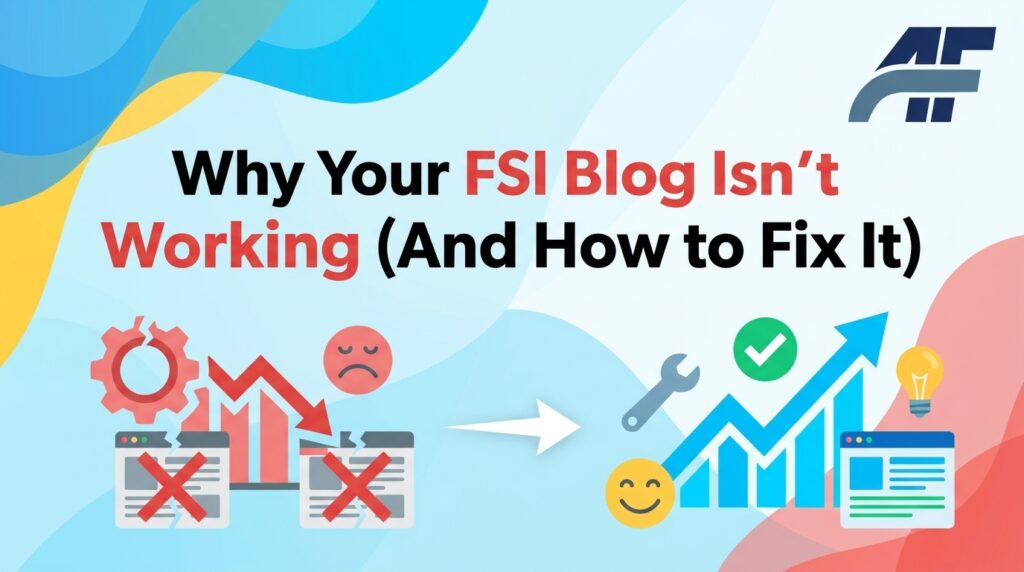
This tutorial explains each of the main causes of an FSI blog’s poor performance and provides a precise solution. Not a theory. Just what is truly effective.
Quick Answer
Quick Answer: Most FSI blogs fail because they mix heavy jargon, no clear reader focus, and no real content plan. To fix it: pick one reader type, simplify every post, and publish on a fixed schedule with real SEO structure. Most people see results when they narrow their topic and stop writing for everyone at once.
Why Your FSI Blog Isn’t Getting Any Traffic
You publish. You wait. Nothing happens. This is the most common complaint from anyone running an FSI blog, and it’s almost never bad luck.
Why It Happens
Search engines rank content that answers a specific question well. If your posts talk broadly about “financial trends” or “the future of finance,” there’s no specific question being answered. Google has nothing to match your post to.
On top of that, most FSI blog posts skip basic on-page SEO. No clear headings. No focused title. No internal links. The post might be well written, but it’s invisible to search.
The Fix
- Pick one specific question per post. Not “banking trends,” but “why small business loan approvals are slower in 2026.”
- Put that exact question in your title and your first paragraph.
- Use H2 headings that match how people actually search, not how you’d phrase it in a meeting.
- Add at least two internal links to other posts on your site so Google can crawl your blog properly.
- Publish on a fixed schedule. Once a week beats ten posts in one month and nothing for three months.
Common Mistakes
- Writing broad “thought leadership” posts with no specific search question behind them.
- Skipping keyword research completely and just writing what feels interesting to you.
- Publishing in bursts, then going silent for weeks, which tells search engines your blog isn’t active.
[RELATED POST: https://websoftocean.com/category/blog-categories/]
Result
Within a few months of consistent, question-focused posts, your FSI blog starts showing up for searches you can actually track. Traffic stops being random and starts being predictable.
Why Readers Bounce Off Your FSI Blog So Fast
In a matter of seconds, people visit your article and depart. It’s not a traffic issue. That is a content issue that is concealed by a traffic issue.
Why It Occurs
Financial subjects are inherently complex. If you don’t get right to the point in your opening paragraph, readers will believe that the entire content is boring and will leave. This is brought on by lengthy introductions, background information, and “in this post we will discuss” openers.
When they are unable to determine if the content is relevant to them, readers also bounce. They are instantly turned off by an ambiguous introduction that doesn’t specify their precise circumstances.
The Fix
- Open with the problem, not the background. State it in the first sentence.
- Cut your intro to 3-4 sentences max. Say what the post covers and move on.
- Break up paragraphs. Three lines max per paragraph on any FSI blog post.
- Use bold text for key terms so skimmers can still get value.
- Add a short summary box near the top for readers who want the answer fast.
Pro Tip: Write your intro last, after you’ve written the full post. You’ll know exactly what to promise once you know what you actually delivered.
Result
Time on page goes up. Readers scroll further because they trust the post will get to the point. That signal alone helps your rankings over time.
Why Your FSI Blog Content Sounds Too Technical for Real Readers
You are well-versed in the topic. The issue is that your readers don’t, and your thick writing turns them off before they get a chance to learn anything.
Why It Occurs
Financial services professionals frequently write in the same manner as they converse with colleagues. This includes regulatory shorthand, acronyms, and presumptive prior knowledge. Sentence one is where a general reader or even a busy professional outside of your specific niche stumbles.
This is not an issue with writing abilities. It’s a habitual issue. Even when plain language is exactly what the reader needs, it becomes “too simple” if you have a thorough understanding of a subject.
The Fix
- Read your draft out loud. Any sentence you’d never actually say to a friend needs rewriting.
- Define every acronym the first time it appears, even ones that feel obvious to you.
- Replace long compound sentences with two short ones.
- Cut any sentence that exists just to sound authoritative instead of to explain something.
- Ask someone outside the industry to read one paragraph. If they’re confused, simplify it.
Common Mistakes
- Assuming “professional” means “formal and dense.” It doesn’t. Clear and short reads as more credible, not less.
- Explaining a term once, then using it without context five paragraphs later.
- Writing for other experts in the field instead of the actual reader searching for help.
Result
Readers finish your posts instead of giving up halfway. That means more shares, more return visits, and a much stronger reputation for your FSI blog as a place that actually explains things.
Why Your FSI Blog Struggles with Compliance and Legal Risk
There’s a solid reason why this one keeps folks awake at night. In financial services content, one negligent post might result in actual legal liability.
Why It Occurs
Unbeknownst to writers, financial information frequently conflicts with regulatory counsel. Unintentionally, a post that specifies a rule that has since changed or casually suggests a certain investing strategy may cross the line.
The majority of blogs lack a review phase. No second pair of eyes checks a post for regulatory correctness or out-of-date assertions before it is published.
The Fix
- Add a standard disclaimer to every post that touches financial advice, clearly stating it’s informational, not personalized advice.
- Build a simple review checklist: check dates on regulations mentioned, avoid specific recommendations, flag anything that sounds like a guarantee.
- Keep a running log of when each post was last checked for accuracy. Financial rules change, and old posts age badly.
- Have someone with compliance knowledge review posts before they go live, even if that’s a quick 10-minute pass.
- Avoid absolute language like “always” or “guaranteed” when discussing outcomes or returns.
Warning: Never state specific numbers, rates, or outcomes as fact without a source and a date. Numbers that were accurate last year can make your FSI blog look careless, or worse, misleading, today.
Result
You publish with confidence instead of anxiety. Your content stays accurate over time instead of quietly becoming a liability sitting on your own site.
[RELATED POST: https://ahmadflow.com/blog/]
Why Your FSI Blog Has No Clear Content Strategy
You’re not short of ideas. You’re lacking on a plan that ties those concepts into something people can follow and trust.
Why It Occurs
Without a plan, blogs wander. One week it’s a deep dive into regulation, the next it’s a listicle, the next it’s silent. Readers can’t create a routine around a blog that doesn’t have a rhythm or a distinct path.
This frequently happens when content becomes considered as a side task, something crammed in between other activities, instead than a meaningful function with its own aims.
The Fix
- Pick three to five core topic buckets your FSI blog will always come back to. Not everything under the sun, just your lane.
- Build a simple content calendar, even a basic spreadsheet, with topics planned a month ahead.
- Set one clear goal per post before you write it: educate, build trust, or answer a specific search question.
- Review performance monthly. Cut topic buckets that never perform, double down on the ones that do.
- Batch your writing. Draft two or three posts in one sitting instead of starting from zero every single time.
Result
Your blog stops feeling random. Readers start to know what to expect, and that consistency builds the kind of trust that turns one-time visitors into regular readers.
Why Your FSI Blog Isn’t Building Trust with Readers
Without trust, traffic doesn’t turn into anything. Nothing else matters if readers don’t trust what you’re saying.
Why It Occurs
Credibility is crucial for financial material. Readers have every cause to be dubious if your FSI blog lacks an author profile, references, and a means of identifying the source of the advise. That mistrust isn’t paranoid; it’s earned.
Even when the material is good, generic stock photographs, ambiguous “our team” wording, and articles without a clear author subtly undermine confidence.
The Fix
- Add a real author name and short bio to every post, with relevant background if you have it.
- Cite sources for any statistic, rule, or claim. Link to the actual source, not just “studies show.”
- Add a simple “last updated” date so readers know the content is current.
- Include an About page that explains who runs the blog and why, in plain language.
- Respond to comments or questions when you can. Real engagement signals a real, accountable source.
Result
Readers start treating your FSI blog as a source they can actually rely on, which means longer visits, more shares, and a much better chance they come back next time they have a financial question.
Why Your FSI Blog Isn’t Ranking on Google
The writing is done by you. Google is still not displaying you. Usually, this is a structural and technological problem rather than a problem with the quality of the material.
Why It Occurs
To determine the purpose of a page and its level of trustworthiness, search engines require unambiguous signals. Even when the text is excellent, a lack of header structure, weak content, sluggish page performance, and missing meta descriptions all subtly lower ranks.
Additionally, new bloggers misunderstand how long actual rankings take. Expecting page one results in the first month is not an indication that something is wrong, but rather a setup for dissatisfaction.