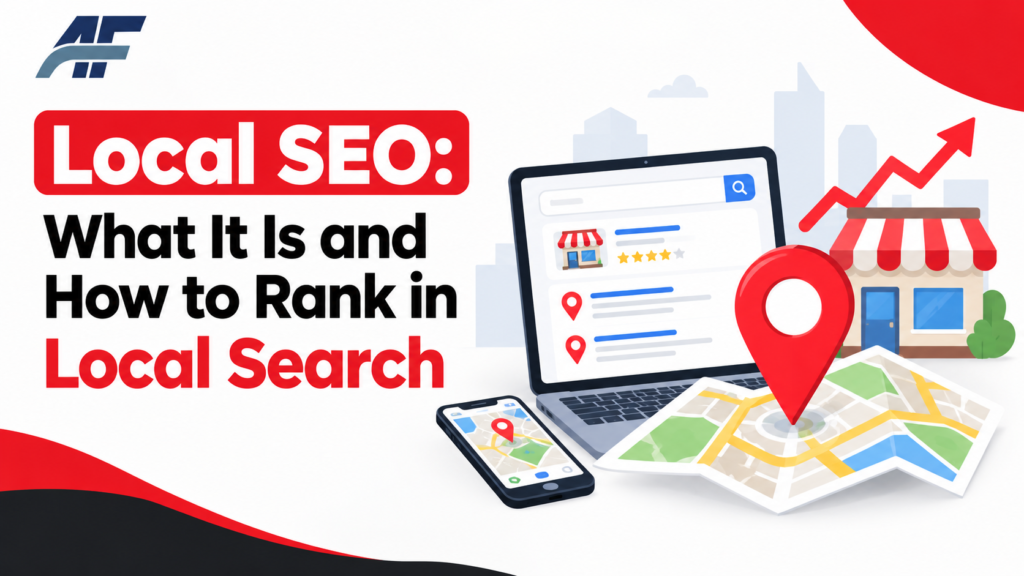
Local SEO: A Simple Guide to Ranking Near You
You run a business in one city or area. You want people nearby to find you when they search. That is what local SEO does.
This guide explains local SEO in plain words. You will learn how it works, which factors matter most, and the steps that help you get a higher search engine ranking in your area. It is written for small business owners and beginners in the United States.
What Is Local SEO?
Quick answer: Local SEO is the work of making your business easier to find in local search results. It helps you show up when people search for a service or store near them, such as “plumber near me” or “coffee shop in Austin.”
Local SEO is a part of regular SEO. Regular SEO tries to get your pages to rank for any searcher, anywhere. Local SEO focuses on people in a certain place.
When someone searches with local intent, Google often shows a map with three business listings. This is called the local pack. It also shows regular web results below it. Local SEO helps you appear in both places.
Why Local SEO Matters
Many searches have a place in mind. A person who searches for a dentist wants one close by. If your business does not show up, that person will call someone else.
Local SEO is useful for:
- Shops and restaurants
- Plumbers, electricians, and other trades
- Dentists, doctors, and lawyers
- Salons and gyms
- Any business that serves customers in a specific area
If you only sell online and have no local customers, local SEO may not fit you.
How Local SEO Works
Quick answer: Google ranks local results using three main factors: relevance, distance, and prominence. Google states this in its own help pages.
Here is what each one means.
| Factor | What it means | What you can do |
|---|---|---|
| Relevance | How well your listing matches what the person searched for | Fill out your profile fully and pick the right categories |
| Distance | How far you are from the searcher or the place named in the search | You cannot change this, but you can make sure your address is correct |
| Prominence | How well known your business is, online and offline | Collect reviews, build mentions, and keep a strong website |
You can read how Google explains this on its page about improving your local ranking on Google.
Distance is the one factor you cannot control. Two businesses can do everything right, and the closer one may still win for a given searcher. That is normal. Focus on relevance and prominence, which you can improve.
Local SEO vs. Regular SEO
Many people mix these up. They share some tools, but the goals differ.
| Regular SEO | Local SEO | |
|---|---|---|
| Goal | Rank for people anywhere | Rank for people in one area |
| Main place to appear | Web results | Local pack, Google Maps, web results |
| Key tool | Your website | Your Google Business Profile and your website |
| Big signals | Content, links, site quality | Profile details, reviews, location, consistent business info |
You need both. A good website supports your local ranking, and a good local profile sends people to your website.
The Main SEO Ranking Factors for Local Search
When people ask about SEO ranking factors, they usually mean everything that affects where a page lands in results. Google does not publish a full list. For local search, though, these areas matter most.
1. Your Google Business Profile
Your Google Business Profile (GBP) is the free listing that shows your business on Google Search and Maps. It is the most important part of local SEO for most businesses.
Set it up like this:
- Claim or create your profile.
- Enter your exact business name, address, and phone number.
- Choose the main category that best describes your business.
- Add other categories that truly apply.
- Set your hours, including holiday hours.
- Add your website link.
- Write a clear business description.
- Upload real photos of your place, team, and work.
- List your services or products.
Common mistake: Adding extra words to your business name, like “Best Plumber Dallas,” when that is not your real name. Google’s guidelines say your name should match your real-world name. Keyword stuffing in the name can get your listing suspended.
2. NAP Consistency
NAP stands for name, address, and phone number. Your NAP should be the same everywhere online. That includes your website, your Google profile, social pages, and business directories.
If one site says “Main St.” and another says “Main Street,” that is a small difference. But big differences, like an old phone number, can confuse people and search engines.
3. Online Reviews
Reviews help people trust you. They also tell Google that real customers know your business. Google lists review count and score as part of prominence.
Good habits:
- Ask happy customers to leave a review.
- Share your review link by email, text, or in person.
- Reply to reviews, both good and bad.
- Stay calm and polite when a review is negative.
Do not pay for reviews or offer gifts in exchange for them. Google’s policies do not allow this. Do not write fake reviews either.
4. Local Citations
A citation is a mention of your business name, address, and phone number on another site. Examples include Yelp, Bing Places, Apple Maps, and local chamber of commerce pages.
Citations help confirm that your business is real and where it is. Start with the major ones. Then add trusted local and industry directories. Quality matters more than quantity.
5. Your Website
Your website supports your local profile. Search engines read it to learn what you do and where you do it.
Make sure your site has:
- Your NAP on every page, often in the footer
- A page for each main service
- A page for each location, if you have more than one
- Fast load times and a mobile-friendly layout
- A clear way to call or visit you
6. Local Content
Content that speaks to your area can help you rank for local searches. Write about the places and problems your customers know.
A roofing company could write about storm damage in its region. A bakery could write about wedding cakes for local venues. Keep it helpful and real.
7. Links and Mentions
Links from other trusted sites show that others vouch for you.
For local businesses, good sources include:
- Local news sites
- Community groups and charities you support
- Local business associations
- Partner businesses
A few strong local links beat many weak ones.
8. Structured Data
Structured data is code that helps search engines understand your page. For local businesses, the LocalBusiness type can describe your name, address, hours, and more. Google explains how in its local business structured data guide.
Structured data does not guarantee a higher spot. It helps search engines read your page more clearly.
[RELATED POST: https://ahmadflow.com/category/seo-tips/]
How to Increase SEO for a Local Business: Step by Step
This is a simple order to follow if you are starting from zero.
- Claim your Google Business Profile. Verify it so you can manage it.
- Complete every field. Add categories, hours, services, photos, and a description.
- Check your NAP. Make sure your business details match everywhere.
- Create profiles on other major platforms. Start with Bing Places and Apple Maps.
- Improve your website. Add service pages, location details, and a mobile-friendly design.
- Ask for reviews. Make it easy for customers to leave one.
- Reply to reviews. Do this on a regular schedule.
- Build local mentions and links. Join local groups and partner with nearby businesses.
- Add local business structured data to your site.
- Track your results. Check how you rank and adjust.
Each step builds on the one before it. Skipping the early steps makes the later ones less effective.
How to Check Your Ranking on Google
A ranking google check tells you where your business shows up for searches that matter to you. Local results change based on where the searcher is. So a simple search from your own phone may not show what a customer sees.
Here are ways to check:
- Search like a customer. Use a service plus a place, such as “electrician in Denver.” Try a few versions.
- Use a private window. This reduces the effect of your past searches.
- Look at your Google Business Profile performance. It shows how people found you, such as through Search or Maps, and how many called or asked for directions.
- Use Google Search Console. It shows which searches lead people to your website and your average position.
- Try a local rank tracking tool. Some tools check rankings from different spots on a map.
Do not take one result as the full story. Look at trends over weeks and months.
Common Local SEO Mistakes
Using a fake address. Some businesses list a virtual office or a P.O. box as a physical location. Google’s rules require a real address for storefront listings. This can lead to suspension.
Ignoring the wrong category. If your main category is off, you may not show for the right searches. Choose the one that matches your core service.
Letting your information go stale. Old hours or a closed-location listing frustrate customers. Update your profile when anything changes.
Skipping review replies. Replies show that a real person runs the business. Many readers look at how owners respond to criticism.
Duplicate listings. More than one profile for the same location can split your signals. Merge or remove duplicates.
Copying the same text across location pages. If you have several locations, write a unique page for each one with real details.
Special Cases
Service-Area Businesses
If you travel to customers and do not serve them at your location, you are a service-area business. You can hide your street address in your Google profile and list the areas you serve instead. Make sure your website also states those areas.
Businesses With Several Locations
Each location should have its own Google Business Profile and its own page on your website. Each page should show that location’s address, phone number, hours, and details.
Online-Only Businesses
If you have no local customers and no physical place, local SEO will not help much. Regular SEO is the better path.
Expert Tips
- Pick categories with care. Your main category is one of the strongest relevance signals in your profile.
- Add photos often. Real, recent photos show that your business is active.
- Use the same name everywhere. Even small changes can cause confusion.
- Answer the questions customers ask. Put those answers on your website. They often match what people type or say into search.
- Be patient. Local SEO tends to build over time. Results rarely come in a few days.
Frequently Asked Questions
What is local SEO in simple words?
Local SEO helps your business show up when people nearby search for what you offer. It works through your Google Business Profile, your website, reviews, and mentions across the web.
How long does local SEO take to work?
It depends on your competition, your starting point, and how much work you do. Some changes, like fixing a wrong category, may show an effect sooner. Building reviews and links usually takes months.
Is a Google Business Profile free?
Yes. Creating and managing a Google Business Profile does not cost money.
Do reviews really help my ranking?
Google lists review count and score as part of prominence, which affects local ranking. Reviews also help people decide to choose you.
Can I do local SEO myself?
Yes. Many small businesses handle the basics on their own: the Google profile, consistent business details, review requests, and a clear website. More competitive markets may need more time and skill.
What is the difference between local SEO and Google Ads?
Local SEO earns free placement in local results over time. Google Ads are paid, and your ad shows when you pay for clicks or views. Ads stop when you stop paying. SEO work can keep helping after you stop actively working on it, though results can still change.
Does my website need to be mobile-friendly?
Yes. Many local searches happen on phones. A page that is hard to read on a small screen can lose visitors fast.
How do I get a higher search engine ranking in my city?
Complete your Google Business Profile, keep your name, address, and phone number the same everywhere, collect honest reviews, and build a clear website with pages for your services and locations. Then track your results and keep your information current.
Final Thoughts
Local SEO helps nearby customers find you at the moment they need you. Google looks at relevance, distance, and prominence. You cannot change distance, but you can improve the other two.
Start with a complete Google Business Profile, accurate business details, honest reviews, and a clear website. Check your ranking on Google from time to time to see what is working. Steady, honest work is what moves a local business up in search results.