Introduction
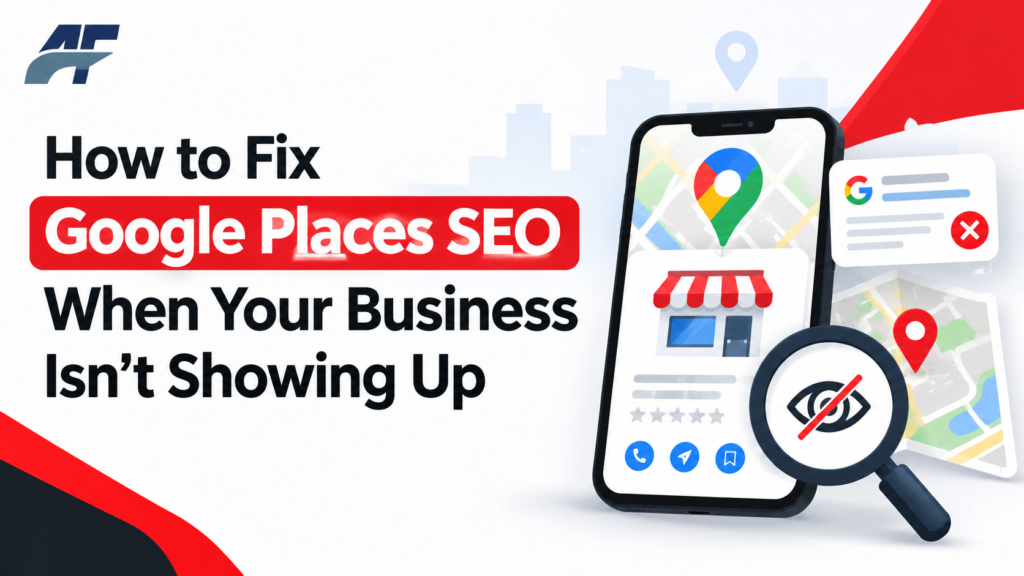
Your business should be showing up on Google Maps. It isn’t. You searched your own business name, and you had to scroll or search twice just to find yourself. Meanwhile, your competitor sits right at the top with reviews, photos, and a full profile.
This is what google places SEO problems look like. You tried adding a few photos. You tried asking one or two friends for reviews. Nothing changed. That’s because most quick fixes only touch the surface. They don’t fix the real reason Google isn’t ranking you.
Here’s the good news. Google places SEO is fixable. It just needs the right steps, done in the right order. This guide will walk you through every fix, why it works, and what changes once you do it.
Quick Answer
Quick Answer: Google places SEO problems happen because your business profile is incomplete, poorly optimized, or missing trust signals like reviews and citations.
To fix it: complete every field in your Google Business Profile, get steady reviews, and use the right keywords in your description and posts.
Most people see results when they fix their profile completeness and review count within the first 30 days.
Why Your Business Isn’t Showing Up in Google Places
You search for your own business and your competitor shows up first. Or worse, you don’t show up at all on the map. This is one of the most common google places SEO problems, and it’s rarely random.
Why It Happens
Google ranks business listings based on three things: relevance, distance, and prominence. If your profile is thin, unverified, or missing key details, Google has nothing solid to match you against a search. Your competitor’s listing is likely more complete, more active, and has more proof that people trust it. Google is not guessing. It’s reading signals. Weak signals mean weak rankings.
The Fix
- Claim and verify your Google Business Profile. If you haven’t verified it, Google treats your listing as less trustworthy. Go to your profile, click verify, and follow the mail or phone steps.
- Fill in every single field. Business hours, phone number, website, service area, and business category. Half-filled profiles rank worse. Full profiles rank better.
- Pick the most accurate primary category. This is one of the strongest ranking signals in google places SEO. Don’t pick a broad category when a specific one fits better.
- Add your service area if you don’t have a storefront. This tells Google exactly where to show you.
Common Mistakes
- Choosing a category that’s close but not exact. This confuses Google’s matching system.
- Leaving your website field blank. This removes a trust signal and a ranking factor.
- Forgetting to update hours after a schedule change. Wrong hours hurt trust and can hurt your ranking.
Result
Once your profile is fully verified and complete, Google has real signals to match you with local searches. Most businesses notice their map visibility improve within two to three weeks.
How to Optimize Your Google Business Profile the Right Way
A lot of business owners think filling in a few fields is enough. It’s not. Google places SEO rewards profiles that are active, detailed, and kept up to date.
Why It Happens
Google’s algorithm favors profiles that show ongoing activity. A profile you set up once and never touched again looks abandoned to Google, even if your business is thriving. Google can’t read your mind. It only sees what you show it.
The Fix
- Write a clear, keyword-rich business description. Use your main service and location naturally. Don’t stuff keywords, just write like you’re explaining your business to a customer.
- Add photos every month. Fresh, real photos of your location, staff, and products signal an active business.
- Use the Products or Services section. List what you actually offer, with clear names and short descriptions.
- Post updates weekly. Google Business Profile posts act like mini ads. They keep your profile active and give you extra space to use keywords naturally.
- Answer the Q&A section yourself. Add common questions and answers before customers do. This gives you control over the message.
Common Mistakes
- Uploading stock photos instead of real ones. Customers and Google both notice the difference.
- Writing a description stuffed with keywords. This reads badly and can get flagged.
Pro Tip: Add at least one new photo every week. Small, steady updates beat one big upload every six months.
Result
An active, detailed profile builds trust with Google and with customers. You’ll start to see more clicks, more calls, and better placement in local search results.
Why Your Google Places Ranking Keeps Dropping
You were ranking fine last month. Now you’ve slipped a few spots, and nothing on your end looks different. This drop is common, and it has clear causes.
Why It Happens
Rankings drop for a few clear reasons: a competitor improved their profile, your review count or rating slipped, your business information became inconsistent somewhere online, or Google updated how it ranks local results. Google places SEO isn’t a one-time task. It’s ongoing, because the businesses around you keep improving too.
The Fix
- Check for information mismatches. Search your business name and see if your address, phone number, or hours differ across websites.
- Look at your review trend. A sudden drop in new reviews, or a new negative review, can shift your ranking.
- Review your competitors’ profiles. See what they added recently. More photos? More reviews? Match and beat it.
- Check for suspended or duplicate listings. These silently hurt your main profile’s ranking.
Common Mistakes
- Assuming a ranking drop is permanent. Most drops are fixable within weeks once you find the cause.
- Ignoring small negative reviews. Even one unanswered bad review can affect trust signals.
Result
Fixing the root cause, not just guessing, brings your ranking back. Businesses that audit and fix these issues usually recover their position within a month.
How to Get More Google Reviews That Actually Help Your Ranking
Reviews are one of the biggest ranking factors in google places SEO, yet most businesses handle them wrong. They wait for reviews to happen instead of building a system.
Why It Happens
Customers rarely leave a review unless asked directly, right after a good experience. Without a system, you get random reviews once in a while, which isn’t enough to compete. Google also looks at review recency and response rate, not just review count.
The Fix
- Ask at the right moment. Right after a purchase, a completed service, or a good interaction, ask directly for a review.
- Send a direct link. Create a short link to your review page and text or email it right away.
- Respond to every review. Good or bad. This shows Google and customers that you’re active and engaged.
- Never buy or fake reviews. Google actively detects and penalizes this, and it can get your listing suspended.
Common Mistakes
- Asking for reviews in bulk all at once. This looks unnatural to Google’s spam detection.
- Ignoring negative reviews instead of responding calmly and professionally.
- Only asking happy customers and skipping the process for everyone else, which creates a suspicious pattern.
Warning: Never offer discounts in exchange for reviews. This violates Google’s policy and can get your profile flagged or removed.
Result
A steady flow of real, recent reviews builds trust fast. Most businesses see a ranking improvement once they hit a consistent review pace, not just a high total count.
How to Fix Duplicate or Incorrect Business Listings
You search your business name and two listings show up. Or your address is wrong on one directory site. This splits your ranking power and confuses Google.
Why It Happens
Duplicate listings usually happen when a business moves, changes its name, or gets listed by a third party without the owner’s knowledge. Incorrect details spread when data aggregators pull old information and republish it across directories.
The Fix
- Search your business name plus your city. Look for any extra listings on Google Maps.
- Request removal of duplicates. Use Google’s “Suggest an edit” option or the support form to flag the duplicate.
- Fix your Name, Address, and Phone number (NAP) everywhere. Check major directories and correct any mismatches.
- Use one consistent format. Same abbreviation style, same phone format, everywhere online.
Common Mistakes
- Ignoring small directory sites. Google still crawls them, and mismatches add up.
- Creating a second listing instead of fixing the original one, which creates a new duplicate problem.
Result
One clean, consistent listing means Google can confidently rank you, instead of splitting trust between two or three weaker profiles.
How to Use Keywords the Right Way in Google Places SEO
Some business owners avoid keywords completely. Others stuff them everywhere. Both approaches hurt your google places SEO instead of helping it.
Why It Happens
Google matches search terms to relevant, natural language. If your profile has zero relevant keywords, Google can’t match you to searches. If it’s stuffed with repeated keywords, Google can flag it as spam or manipulation.
The Fix
- Use your main service and location naturally in your business description. Write it the way you’d explain your business to a person, not a search engine.
- Add keywords to your services list. Use the actual names customers search for, not vague terms.
- Use keywords in your Google posts. Each post is a chance to reinforce relevance without stuffing your main profile.
- Match your website content to your profile. Consistency between your website and profile strengthens relevance signals.
Common Mistakes
- Repeating the same keyword phrase multiple times in one description.
- Using generic terms instead of the exact terms customers actually search.
Result
Natural, well-placed keywords help Google understand exactly what you offer and where. This improves your match rate for the exact searches your customers are already making.
How to Build Local Citations That Actually Help Your Ranking
Citations are mentions of your business name, address, and phone number across the web. Missing or messy citations quietly hurt your google places SEO, even if your profile looks perfect.
Why It Happens
Google cross-checks your business details across other sites to confirm you’re real and trustworthy. If your details are missing from major directories, or inconsistent between them, Google has less confidence in your listing.
The Fix
- List your business on major directories. Focus on well-known, relevant platforms for your industry.
- Keep your NAP details identical everywhere. Same spelling, same format, every single time.
- Prioritize quality over quantity. A handful of strong, accurate citations beats fifty weak or outdated ones.
- Update old citations when your details change. Don’t let old addresses or numbers sit online.
Common Mistakes
- Listing on low-quality directories that add no real trust value.
- Forgetting to update citations after a business move or rebrand.
[RELATED POST: https://ahmadflow.com/category/seo-tips/]
Result
Clean, consistent citations reinforce your business as real and trustworthy. This strengthens the prominence signal Google uses when ranking local listings.
Why Your Competitors Rank Higher Than You
You’ve done the basics, but a competitor still outranks you every time. This usually comes down to a gap you haven’t noticed yet.
Why It Happens
Ranking is relative. Google isn’t just checking if your profile is good, it’s comparing your profile against every other business competing for the same search. If your competitor has more reviews, more photos, or more consistent activity, they win the comparison even with a similar business.
The Fix
- Study your top three competitors’ profiles. Note their review count, photo count, and posting frequency.
- Match or beat their review pace. If they get five reviews a month, aim for seven or eight.
- Check their categories and services. See if they’re using a category or keyword angle you missed.
- Improve your response time and rate. Fast, professional responses to reviews and questions build trust faster.
Common Mistakes
- Copying a competitor’s exact description word for word, which can look duplicated and low quality.
- Focusing only on their weaknesses instead of also matching their strengths.
Pro Tip: Set a recurring monthly reminder to check your top competitor’s profile. Small, steady improvements on your side add up over time.
Result
Once you close the gap in reviews, photos, and activity, your ranking moves up naturally. Google rewards the business that consistently shows more effort and trust.
How to Track and Measure Your Google Places SEO Results
You made changes, but you’re not sure if they’re working. Without tracking, you’re guessing, and guessing wastes time.
Why It Happens
Most business owners check their ranking once, then forget to check again. Without regular tracking, small wins go unnoticed and problems get caught too late.
The Fix
- Use Google Business Profile Insights. Check views, calls, and direction requests monthly.
- Track your position for key search terms. Search your main service plus your city regularly, ideally from a private browser window.
- Watch your review count and rating trend. A steady increase means your review strategy is working.
- Set a monthly check-in. Same day each month, review your numbers and adjust your approach.
Common Mistakes
- Checking rankings from a personal, logged-in browser, which can show skewed results based on your search history.
- Giving up after two weeks. Google places SEO improvements often take a full month to show clearly.
Result
Regular tracking shows you exactly what’s working and what needs more attention. You stop guessing and start making decisions based on real data.
FAQ
Why is my business not showing up on Google Maps at all?
This usually means your listing isn’t verified, was suspended, or is a duplicate competing with your main profile. Start by searching your exact business name and address to see if any listing appears. If nothing shows up, check your Google Business Profile dashboard for a suspension notice. If a listing shows but it’s incomplete, verify it fully and fill in every field. Most invisible listings come back within one to two weeks after verification and a complete profile.
How do I fix a suspended Google Business Profile?
A suspension usually happens due to a policy violation, like fake reviews, an incorrect address, or a mismatched business name. Log into your dashboard and check for a specific reason. Fix the issue directly, then submit a reinstatement request through Google’s support form. Be specific and honest about what you fixed. Reinstatement can take anywhere from a few days to a few weeks, so keep your business information accurate going forward to avoid repeat suspensions.
What causes a sudden drop in Google Places ranking?
Sudden drops usually trace back to a review count slowdown, a new negative review, inconsistent business information across the web, or a competitor improving their profile. Check your review trend first, since this is the most common cause. Then verify your NAP details are consistent everywhere. Google places SEO rankings shift based on relative comparison, so a competitor’s improvement can lower your position even if nothing changed on your end.
How many Google reviews do I need to rank well?
There’s no fixed number, but consistency matters more than total count. A business with 20 reviews arriving steadily over six months often outranks one with 100 reviews from two years ago and nothing since. Focus on getting a few new, genuine reviews every week rather than chasing a specific total. Recency and response rate carry real weight in how Google evaluates trust and activity.
Why does my competitor rank higher with fewer reviews?
Reviews are only one ranking factor. Your competitor may have a more complete profile, a more accurate category, stronger citations, or more frequent posts and photo updates. Compare their full profile against yours, not just the review count. Google places SEO looks at the whole picture, including relevance and consistency, not a single metric.
How long does it take to see Google Places SEO results?
Most businesses start seeing measurable movement within two to four weeks of consistent effort. Full results, especially for competitive local searches, can take two to three months. This depends on how competitive your industry and area are. Steady, ongoing effort matters more than one big burst of changes, since Google favors businesses that stay active over time.
Should I use the same keywords Google Ads uses for Google Places SEO?
Not exactly. Google Places SEO relies on natural language in your description, services, and posts, while ads often use short, punchy phrases built for clicks. Use the actual terms your customers search for, written the way a real person would describe your service. Avoid repeating the same phrase multiple times, since this can look like keyword stuffing rather than natural relevance.
Can I improve Google Places SEO without a physical storefront?
Yes. If you serve customers at their location, set up a service area business profile instead of a storefront listing. Define your service area clearly, keep your category accurate, and follow the same review and posting strategy. Google still ranks service area businesses in local searches, as long as the profile is complete and active.
What’s the difference between Google Places SEO and regular SEO?
Regular SEO focuses on ranking your website in general search results. Google places SEO focuses specifically on ranking your business listing in Google Maps and the local map pack. Both matter, but they use different signals. Places SEO leans heavily on your business profile, reviews, and citations, while website SEO leans on content, backlinks, and site structure. A strong local strategy uses both together.
Conclusion
Your google places SEO problem is fixable. It’s not bad luck, and it’s not something only big companies can solve. It comes down to a few clear things: a complete and verified profile, a steady flow of real reviews, consistent business details everywhere online, and regular activity that shows Google you’re a real, active business.
Start with the profile. Fill in every field, pick the right category, and verify it today if you haven’t already. Then build a simple system to ask for reviews right after every good customer interaction. Small, steady effort beats one big push that fades after a week.
Pick one fix from this guide and do it right now. Your ranking won’t fix itself, but it will fix with the right steps, done consistently.