
Introduction
You’re looking at the Canon T6 digital SLR camera and wondering if it’s actually a good buy, or if you’re about to spend money on outdated gear. Maybe you already read a few reviews that contradict each other. One says it’s a great starter camera. Another says skip it and get something newer.
You don’t make any decisions as a result of that back and forth. It simply squanders your time.
That is cut thru by this guidance. You’ll receive a detailed explanation of the T6’s strengths, weaknesses, compatible lenses, and suitability for your intended use.
A Brief Response
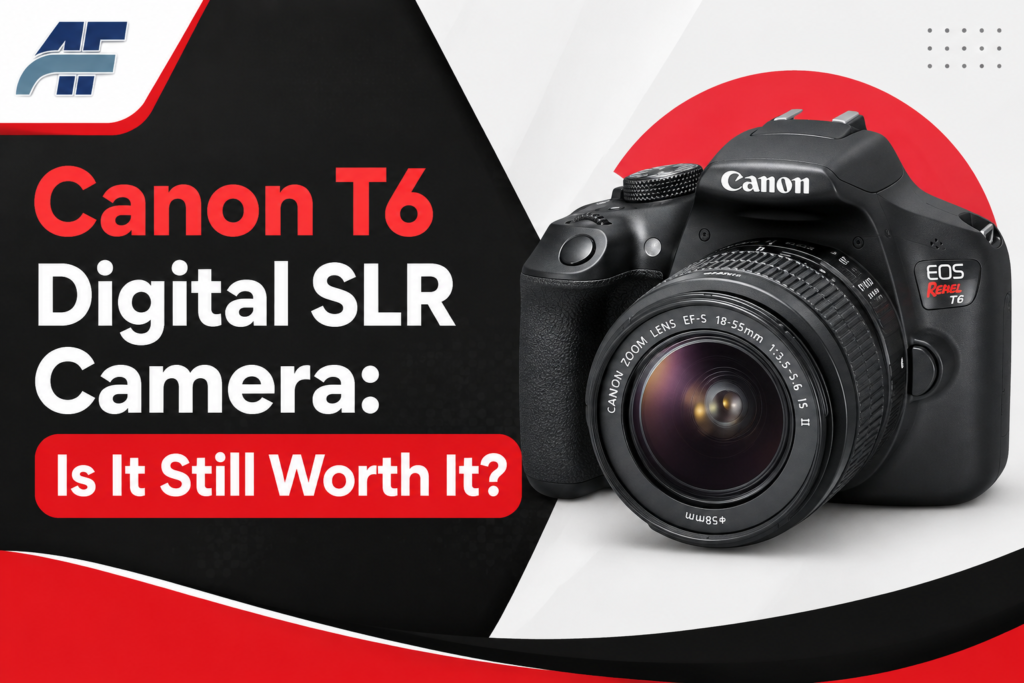
Quick Response: With an 18-megapixel sensor, a 9-point focusing system, and integrated Wi-Fi, the Canon T6 digital SLR camera (also known as the EOS 1300D or model DS126621) is an entry-level DSLR. For novices learning the fundamentals of photography and shooting in excellent light, it works wonderfully. It is not designed for quick motion or professional video production, and it has trouble in low light.
Canon T6 Autofocus Feels Slow or Misses Shots
Why It Happens
Only the center point of the T6’s nine-point focusing mechanism is a more precise cross-type sensor. By today’s standards, that is a rudimentary setup. It can be readily outpaced by subjects that move quickly, such as children running or dogs.
The Fix
- Use the center focus point. Frame your subject in the middle of the shot, focus, then recompose if you need the subject off-center.
- Switch to AI Servo mode for anything moving. This tells the camera to keep adjusting focus instead of locking once.
- Add more light. Autofocus systems like this one work faster and more accurately when there’s enough light hitting the sensor. Shooting near a window or outdoors gets noticeably better results than a dim room.
- Avoid relying on Live View autofocus. It’s slower on this camera than the viewfinder-based system, since it uses a different focusing method.
Result
Your keeper rate goes up once you match your shooting style to what the autofocus can actually handle. It won’t match a modern camera, but it becomes far more predictable.
Common Mistakes: Trying to track fast sports or wildlife with this body. It’s not built for that job, no matter how you set it up.
Canon Rebel T6 Photos Look Grainy in Low Light
Why It Happens
High ISO performance is not intended for the T6’s sensor and CPU combo. Noise becomes apparent at ISO 1600 or so, particularly in shadowy places.
The Fix
- Keep your ISO as low as the lighting allows. Check your settings before you shoot indoors or at night.
- Use a wider aperture lens (lower f-number) to let in more light without raising ISO.
- Add a simple external flash for indoor shots instead of relying on the built-in one.
- Shoot in RAW format, not JPEG. This gives you more room to reduce noise afterward without destroying detail.
Result
Your low-light shots come out cleaner, with less grain in shadows and more usable detail overall.
[RELATED POST: https://www.amazon.com/Canon-Digital-Camera-18-55mm-3-5-5-6/dp/B06XNTPN8C]
Which Canon Rebel T6 Lenses Actually Work Well
Why It Happens
Compared to full-frame EF mount cameras, the T6’s EF-S lens mount is smaller. Choosing the incorrect Canon lens is a waste of money because not all of them fit.
The Fix
The T6 kit usually ships with the EF-S 18-55mm IS II lens, which covers everyday shooting but isn’t fast in low light. Beyond that:
| Lens | Best For | Note |
|---|---|---|
| EF-S 18-55mm IS II | General everyday shooting | Comes with most kits |
| EF 50mm f/1.8 STM | Portraits, low light | Affordable and sharp |
| EF-S 55-250mm IS STM | Zoom, distant subjects | Good for sports or wildlife at a distance |
Any EF-S or EF lens will physically fit and work with the T6. EF-M lenses, made for Canon’s mirrorless cameras, will not.
Result
Picking the right lens for what you actually shoot matters more than the camera body itself. A $125 prime lens can improve your photos more than any camera upgrade.
[RELATED POST: https://ahmadflow.com/]
Canon T6 Videos Look Choppy or Low Quality
Why It Happens
The T6’s maximum video quality is 1080p at 30 frames per second. Additionally, it employs contrast-detect focusing during video, which does not lock smoothly but instead hunts back and forth.
The Fix
- Set focus manually before recording instead of relying on autofocus during the clip.
- Shoot at 1080p30, the camera’s strongest video setting, rather than lower resolutions.
- Use a tripod or stabilizer. The camera has no in-body stabilization, so handheld footage shakes more than you’d expect.
- Add an external microphone if audio quality matters, since the built-in mic picks up a lot of handling noise.
Result
Your footage looks steadier and better focused, even without upgrading equipment.
Warning: Don’t expect 4K video from this body. It was never built to shoot it, and no firmware update changes that.
Is the Canon T6 Camera Review Verdict Still Positive Today?
Why It Happens
The T6 is an older entry-level model, and camera technology is advancing quickly. That makes people second-guess buying one now, even at a lower price than newer options.
The Fix
Judge it against what you’ll actually use it for, not against flagship cameras released years later.
- Good fit: learning photography basics, casual family photos, daylight outdoor shooting, budget-conscious beginners.
- Not a good fit: professional work, fast sports or wildlife photography, low-light event photography, serious video projects.
Pro Tip: If you’re buying used, check the shutter count if the seller has it. DSLR shutters wear out over tens of thousands of actuations, and a heavily used body may need replacing sooner.
Result
You end up with realistic expectations, which is the actual reason most negative reviews exist in the first place. People expected a professional camera and got a beginner one.
FAQ
Why is my Canon T6 autofocus not working well indoors?
Indoor lighting usually isn’t bright enough for the T6’s 9-point autofocus system to work quickly. Switch to the center focus point, add more light where you can, and avoid relying on Live View mode, since it focuses more slowly than the standard viewfinder mode on this camera.
What lenses fit the Canon Rebel T6?
Any EF or EF-S mount lens fits and works fully with the T6. EF-S lenses are made specifically for cropped-sensor bodies like this one. EF-M lenses, built for Canon’s mirrorless line, do not fit this camera at all.
How do I fix grainy photos on my Canon T6?
Grain usually comes from a high ISO setting in low light. Lower your ISO, use a wider aperture lens, and shoot in RAW format so you have more control when editing. Adding external light also reduces the need for high ISO in the first place.
Is the Canon T6 good for beginners?
Yes. It’s built as an entry-level DSLR, with straightforward controls and guided modes. It handles daylight and general shooting well. Just don’t expect strong performance in low light, fast action, or professional video work, since it wasn’t designed for those situations.
What is the Canon DS126621 model number?
DS126621 is the internal model number printed on the T6 body, also sold as the EOS 1300D in some regions. It refers to the exact same camera, not a different version, so specs and compatible lenses are identical either way.
Should I buy a Canon T6 camera kit now or wait?
If your budget is tight and you’re learning photography basics, the kit remains a reasonable buy, especially at its current lower price point. If you need strong low-light or video performance, look at a newer model instead, since the T6 wasn’t built for those needs.
In conclusion
It’s not a horrible camera, the Canon T6 digital SLR. It’s simply an entry-level, older model, and the majority of complaints about it are from people expecting more from it than it was designed to provide.
Use manual focus for video, use the appropriate lens for what you really capture, and maximize your ISO and illumination. When you do that, this camera performs admirably for learning, informal shooting, and daytime photography.
Start with the lens you’re using if you already have one. Usually, that one adjustment has the most impact on your outcomes.