Introduction
You continue to hear about artificial intelligence in real time, but you are still unable to understand its true implications. Not in theory. Not on a white paper. In your real life, your real job, and your real issues.
The majority of the explanations you’ve come across are either too ambiguous to be helpful or too technical to understand. They discuss neural networks and machine learning models, but they never explain what they perform on an actual system at this very time.
That’s the gap this article closes.
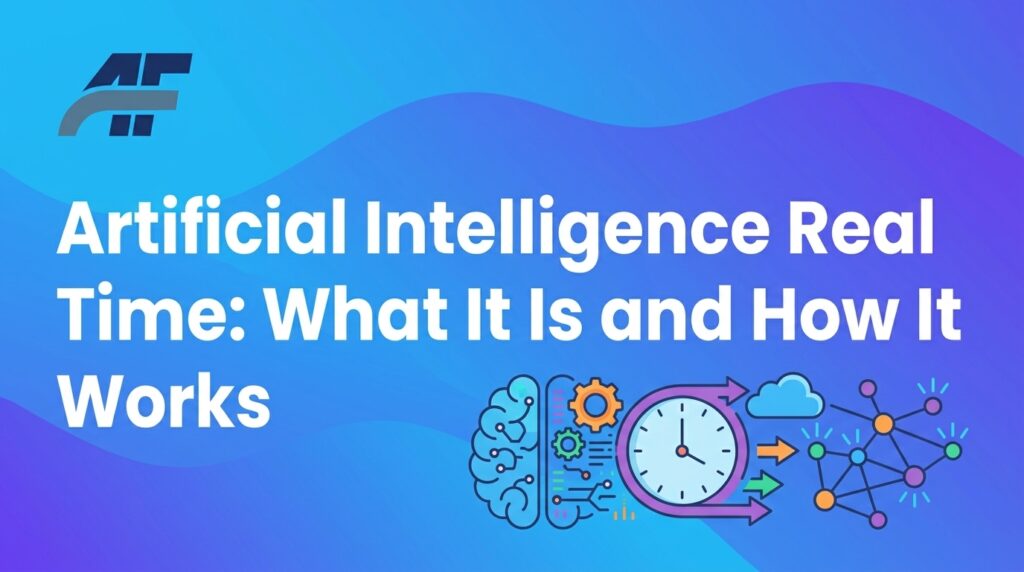
Artificial intelligence real time means AI that acts instantly – not after an hour of processing, not after a batch job runs overnight, but in the moment something happens. It’s what makes your navigation app reroute you around traffic before you hit it. It’s what stops a fraudulent charge on your card before it clears. It’s what powers the artificial intelligence apps you probably already use every day without thinking about it.
If you’ve been trying to understand what is AI used for, or looking for real examples of AI that go beyond the buzzwords, you’re in the right place. This article covers how real-time AI works, where it’s being used right now, what the common problems are, and how to work with it instead of getting left behind by it.
No jargon walls. No academic detours. Just clear, usable information from start to finish.
Quick Answer
In a nutshell, real-time artificial intelligence refers to AI systems that analyze data and react to events in milliseconds or less. Fraud detection, navigation, healthcare monitoring, customer service, and more areas use it. When most consumers look at the artificial intelligence programs they currently use on a regular basis, such as voice assistants, banking notifications, and maps, they begin to grasp it.
What Artificial Intelligence Real Time Actually Means
A lot of people think AI is something that runs in the background, slowly crunching data and spitting out a report later. That’s one type. But artificial intelligence real time is completely different.
Real-time AI doesn’t wait. It processes input the moment it arrives and responds before you’ve had time to blink. It’s the difference between a smoke alarm that tells you about a fire after it’s already burned down your kitchen, and one that detects heat changes in milliseconds and alerts you the second something starts going wrong.
Why the Confusion Happens
The majority of people learn about AI through non-real-time instances. A lot of AI still uses batch processing, in which a machine gathers input, analyzes it later, and generates findings. reports every night. Model retraining every week. examination of trends every month.
The architecture of real-time AI is distinct. Because it makes use of streaming data pipelines, data moves through the system constantly rather than in discrete pieces. At the conclusion of the process, the AI model makes judgments based on each new piece of information. It doesn’t wait for the entire dataset. It uses what it has at the moment.
This is harder to build and more expensive to run, which is why many companies still rely on batch AI for things where speed doesn’t matter. But for anything where timing is the whole point – fraud, medical emergencies, traffic, security – real-time AI is the only thing that makes sense.This is harder to build and more expensive to run, which is why many companies still rely on batch AI for things where speed doesn’t matter. But for anything where timing is the whole point – fraud, medical emergencies, traffic, security – real-time AI is the only thing that makes sense.
How It Works in Practice
Consider instances of AI that you have come across without giving them any thought. When you swipe your card at a coffee shop, the transaction is checked in less than 300 milliseconds. Before the cashier has finished examining you, it either accepts or flags the transaction based on your location, spending history, merchant type, quantity, and thousands of other signals.
That’s AI in real time. It was not evaluated by a human. At midnight, no batch task was executed. A decision was made at machine speed, and it occurred in real time.
Common Mistakes People Make
- Assuming all AI is real-time. A lot of AI runs on schedules. If you’re expecting instant results from a system that’s built for batch processing, you’ll always be disappointed.
- Confusing fast with real-time. A system that responds in five seconds feels fast to a human. But in AI terms, it’s not real-time – real-time means milliseconds, not seconds.
- Thinking real-time AI is always better. For some uses of AI – like medical imaging analysis or training a new model – taking more time produces better results. Speed isn’t always the goal.
Result
You can stop anticipating the incorrect thing from each system once you know the difference between batch and real-time AI. You can make better choices about what to trust, utilize, and create with since you are aware of which AI apps are designed for speed and which are designed for depth.
What Is AI Used For in Real Time – The Real Answer
People ask “what is AI used for” and get a list that reads like a tech investor’s pitch deck. Autonomous vehicles. Space exploration. Predicting climate change. Fine. But that’s not what most people mean when they ask the question.
What you probably mean is: what does real-time AI actually do in situations I encounter? Here’s the real answer.
Why Generic Lists Don’t Help
The majority of lists of AI applications are either overly general or overly specific. They either provide you information that is too general to be useful (“AI is used in healthcare”) or too specialized to be useful (“AI helps radiologists detect rare bone tumors”). Neither aids in your comprehension of what this technology is doing all around you on a daily basis.
In situations when a person would be too sluggish, real-time AI is being employed. This is a more helpful frame. Real-time AI is either now here or on the horizon whenever a choice needs to be made more quickly than a human can comprehend.
The Fix – A Clearer Map of Real-Time AI Uses
Here’s where real-time AI is actually working right now, in categories that matter to most people:
Financial services:
- Card fraud detection – every swipe triggers a real-time model
- Loan pre-approval systems that give instant decisions
- Stock trading algorithms that execute in microseconds
Navigation and transport:
- Map apps that recalculate your route as traffic changes
- Ride-share apps that match you to a driver in seconds
- Traffic light systems in some cities that adjust timing based on live vehicle flow
Healthcare:
- Patient monitoring systems in hospitals that alert staff to changes in vital signs instantly
- Wearable devices that detect irregular heart rhythms as they happen
- Emergency triage tools that flag high-risk patients in real time
Customer experience:
- Chatbots that respond to you instantly (the good ones use real-time AI, not scripted trees)
- Product recommendation engines that update the moment you click something
- Spam filters that block emails before they reach your inbox
Security and safety:
- Facial recognition at access-controlled entry points
- Cybersecurity systems that detect and block intrusions as they happen
- Content moderation on platforms that flags harmful posts before they go viral
Common Mistakes
- Thinking AI only matters in tech or finance. Real-time AI is inside hospital equipment, inside your car, and inside the customer service line you called last Tuesday.
- Assuming the AI examples you’ve seen represent all of AI. The visible examples are only a fraction of where AI is running right now.
Result
The idea becomes tangible rather than abstract when you witness real-time AI applied to scenarios you can genuinely identify. You begin to see it everywhere, and this awareness enables you to ask more insightful questions about the tools you employ.
Examples of AI Running Right Now That You Already Use
To already have real-time AI working for you, you don’t have to be a developer or a computer enthusiast. It’s likely that you use several instances of AI on a daily basis and refer to them by different names.
Why People Don’t Recognize AI When They’re Using It
Branding is one aspect of the issue. Typically, businesses don’t state that “our real-time AI model processed your request.” They refer to “smart suggestions,” “instant results,” or even “personalized recommendations.” The AI is meant to feel more like magic than technology, which is why it is intentionally undetectable.
Another problem is that real-time AI frequently performs so effectively that you only become aware of its shortcomings. When your card is flagged for a purchase you really made, you become aware of it. The 500 fraudulent transactions that the same technology stopped last week go unnoticed by you.
Real Examples of AI You’re Already Using
Voice assistants. When you ask your phone a question and get an answer in two seconds, that’s real-time AI. Your voice is converted to text, the text is processed by a language model, and a response is generated – all within the time it takes you to exhale.
Email spam filters. Every email that lands in spam instead of your inbox was scored by a real-time classification model. It analyzed the sender, the content, the links, the formatting, and dozens of other signals in milliseconds.
Streaming service recommendations. The row of shows “recommended for you” isn’t static. It updates based on what you watch, when you pause, what you skip, and what you finish – often in real time as you browse.
Auto-correct and predictive text. Every word suggestion your keyboard offers is generated by a language model running on your device or in the cloud. Real-time, every keystroke.
Search suggestions. The moment you start typing in a search bar, a model is predicting what you’re going to type and offering completions based on what millions of other people searched for.
Navigation apps. Your map isn’t showing you a static route. It’s checking live traffic data, incidents, road closures, and estimated travel times – and it recalculates faster than you can react to a missed turn.
Common Mistakes
- Dismissing familiar tools as “just apps.” Most artificial intelligence apps you use daily are running sophisticated real-time models. They’re not simple.
- Thinking you need to do something special to use AI. You’re already using it. The question is whether you’re using it intentionally.
Pro Tip:
Check your transaction history by opening your banking app. A real-time fraud model rated each of those transactions as soon as it occurred. That’s hundreds of times a year, real-time AI makes financial decisions without your knowledge.
The outcome
You cease considering AI to be futuristic if you see real-time AI in the technologies you already use. It exists. It’s functioning. Using it more purposefully is the next stage.
[Internal Link]https://ahmadflow.com/
[External Link]https://websoftocean.com/
The Biggest Problems With Artificial Intelligence Real Time
AI in real time is not flawless. If you plan to create with it or rely on it, you must be aware of its actual failure mechanisms.
Why Real-Time AI Fails
Real-time AI is both strong and vulnerable due to the same factor. It moves quickly. Additionally, moving quickly entails taking action before all the knowledge is accessible. Acting on inadequate, skewed, or distorted data is sometimes necessary.
A human may occasionally make a mistake while making a quick judgment based on insufficient knowledge. When an AI system makes the same quick choice on a large scale, it commits a mistake and the consequences worsen.
The Most Common Failure Modes
issues with latency. Fast data movement is essential to real-time AI. The AI’s reaction time deteriorates if the data pipeline slows down due to server load, network congestion, or a poor connection. A fraudulent charge may clear before the system detects it if there is even a slight delay, such as a few seconds.
drift of the model. Historical data is used to train AI algorithms. Over time, the model’s judgments become less accurate as the actual world changes—new fraud patterns, new user behaviors, new product categories. Regular retraining is necessary for real-time AI. The majority of systems don’t receive adequate retraining.
False positives. Real-time AI makes fast binary decisions: approve or deny, show or hide, flag or pass. When the model is wrong and flags something legitimate as a problem, the cost is real. Your card gets declined at dinner. A valid post gets removed. A real customer gets locked out of their account.
Bias in training data. If the data used to train the model reflects historical patterns that were themselves biased, the model replicates those patterns in real time. At scale. Automatically. Without anyone noticing until the damage is done.
Adversarial attacks. Some actors specifically try to fool real-time AI systems. Fraudsters study how fraud detection models work and design transactions to look legitimate. Spammers tweak emails to slip past filters. This is a permanent cat-and-mouse game.
The Fix – What Good Real-Time AI Systems Do About These Problems
- They always keep an eye on their own performance. Real decision quality, not simply uptime. They monitor accuracy, response times, and false positive rates in relation to labeled test data.
- They retrain models on a regular basis; some systems retrain every day in response to fresh data.
- For edge instances, they incorporate human evaluation. The model does not make all of the decisions. A person is involved in high-stakes judgments.
- In order to help engineers understand why the model produces incorrect decisions and address the underlying reason, they employ explainability tools.
Common Mistakes
- Naively relying on real-time AI because of its speed. Accuracy and speed are not the same. Make sure the system is protected at all times.
- Disregarding false positives as legitimate losses. There is a true cost associated with each false positive. Effective systems reduce them and provide transparent appeal or override procedures.
Result
You won’t be shocked when real-time AI makes a mistake if you are aware of its failure modes, and you will know what to look for when assessing an AI system’s dependability.
How Artificial Intelligence Apps Use Real-Time AI to Solve Daily Problems
Artificial intelligence apps aren’t just novelties. The best ones are solving real problems – saving time, preventing loss, improving decisions – in ways that matter to everyday people.
Why Most People Underestimate What These Apps Are Doing
When an app works perfectly, you don’t think about it. You get directions, make a payment, finish a call – and move on. The AI that made those things work correctly is invisible. You only start noticing it when you actually look at what’s happening under the hood.
Most people have never done that. And once they do, the response is usually somewhere between “that’s impressive” and “that’s a lot of power in one place.”
Real-Time AI in the Apps You Actually Use
Fitness and health apps. The better ones don’t just log your steps. They analyze your activity patterns, your sleep data, and your heart rate trends to give you real-time feedback. Some wearables now detect atrial fibrillation – a serious heart condition – in real time and alert you to see a doctor before you’ve noticed any symptoms.
Language translation apps. Point your camera at a sign in another language and see the translation overlaid on the image in real time. The model is processing each frame of video as it comes in, identifying text, translating it, and rendering the result – all in under a second.
Customer service chatbots. The frustrating ones are scripted. The good ones use real-time language models to understand what you’re actually asking, not just matching keywords to pre-written responses. They can handle follow-up questions, context from earlier in the conversation, and unusual phrasing.
Content moderation tools. Social platforms run real-time AI across every post, image, and video uploaded. The AI doesn’t read every word – it scores content for probability of policy violations and escalates high-risk content to human reviewers.
Smart home devices. When your smart thermostat adjusts before you get home, it’s using real-time data – your phone’s location, the time, the outside temperature, your historical preferences – to make a decision without being asked.
Common Mistakes
- Anticipating identical capabilities from all AI applications. While both a simple chatbot and a real-time medical monitoring system are classified as “AI,” they are quite different. Don’t evaluate all AI apps based on the worst ones you’ve seen.
- Disregarding privacy settings in apps driven by AI. Data is necessary for real-time AI. Certain applications require more than they require. Verify what information your applications are gathering and if you are okay with it.
Warning: Artificial intelligence apps that promise real-time results without explaining how often aren’t using real-time AI at all. They’re using cached responses, pre-generated answers, or simple lookup tables. If speed matters to you, ask how the system works before trusting it.
Result
When you understand what real-time AI is doing inside your everyday apps, you can choose better tools, set better expectations, and get more value out of what you’re already using.
Applications of AI in High-Stakes Situations Where Real Time Matters Most
Convenience is a factor in several AI applications. Others focus on survival. Real-time AI is not a luxury in high-stakes areas like infrastructure, healthcare, and safety. That’s the whole idea.
Why Timing Is Everything in These Contexts
It irritates me when a recommendation engine makes a small mistake. It is risky for a medical monitoring system to make a mistake. The importance of the AI operating accurately and quickly increases with the stakes. A one-second delay can have difficult-to-reverse effects in some situations.
Healthcare Monitoring
Hospital ICUs now use AI systems that monitor dozens of patient vital signs simultaneously, 24 hours a day. A human nurse can check vitals every 15-20 minutes. The AI checks them every second.
When a patient’s oxygen levels start dropping or their heart rhythm changes, the system flags it instantly. Staff are alerted before the patient goes into crisis, not after. Studies have shown that this type of early warning system reduces cardiac arrests in monitored units. Real-time AI isn’t replacing the nurse – it’s giving the nurse 20 extra minutes of warning.
Emergency Services and Dispatch
Some emergency dispatch systems now use real-time AI to help prioritize calls and suggest resource allocation. When multiple calls come in simultaneously, the AI helps dispatch teams identify which situations are most critical and which units are closest. That’s lives affected by a decision that happens in under 30 seconds.
Cybersecurity
A cyberattack may spread across a network in a matter of seconds. Conventional security systems are constantly looking backward since they identify threats by reading records. In cybersecurity, real-time AI monitors network traffic as it moves, spots irregularities, and stops questionable behavior before it reaches its intended target.
Infrastructure Management
Real-time artificial intelligence (AI) is being used more and more to manage transportation networks, power grids, and water treatment systems. This AI detects abnormalities, anticipates equipment failure, and automatically modifies load distribution. Rolling blackouts can be avoided before they begin, rather than after 10,000 people have lost power, if a power system employs real-time AI to regulate load.
Common Mistakes
- Assuming that because something is automated, it doesn’t need human oversight. In high-stakes AI applications, the human in the loop isn’t optional. It’s essential.
- Deploying real-time AI in critical systems without testing under failure conditions. Systems fail. Real-time AI systems can fail fast and at scale. Testing what happens when the AI is wrong is just as important as testing when it’s right.
Pro Tip: If you’re evaluating a real-time AI system for something high-stakes, the first question to ask isn’t “how accurate is it?” It’s “what happens when it’s wrong?” A system that fails safely is worth more than one that’s 99% accurate with catastrophic failure modes.
Result
In high-stakes applications of AI, real-time processing isn’t about convenience – it’s about giving people more time to respond, more information to act on, and better outcomes in situations where every second matters.
How to Actually Work With Artificial Intelligence Real Time
It’s one thing to comprehend real-time AI. Working with it is another, whether you’re a tool evaluator, a business owner, or a user. Here’s how to do it effectively.
Why Most People Get This Wrong
The majority of people treat AI tools in the same manner as they do other software: install it, use it, and presume it functions. For a word processor, that is OK. When a real-time AI system makes judgments on your behalf, it’s not acceptable.
Real-time AI needs active engagement. It needs you to check its outputs, give feedback, adjust its settings, and stay aware of when it’s working well versus when it’s drifting off course.
If You’re a User of Real-Time AI Tools
- Recognize the decisions the AI is making for you. You might not be aware that the majority of real-time artificial intelligence applications are making calls. Recognize which ones have an impact on you.
- Look for choices for overrides. You may overrule the decisions made by good AI systems. It’s a warning sign if a tool doesn’t allow you to fix errors.
- Report mistakes. The majority of AI systems learn from user feedback. If a valid email is incorrectly tagged by the spam filter, label it as “not spam.” The model is updated with that adjustment.
- Check your settings from time to time. AI learns from your actions in real time. Your settings may need to be adjusted if your behavior changes.
If You’re Evaluating Real-Time AI for Your Business
- Describe “real time” in terms of your use case. It refers to milliseconds for fraud detection. It might imply less than two seconds for customer service. Prior to evaluating tools, be specific.
- Inquire about latency assurances. You should be able to find out the p95 and p99 reaction times of any vendor offering real-time AI. They’re not serious about real-time if they can’t.
- Inquire about the frequency of model retraining. A model that was trained on outdated data six months ago is providing you with quick historical insight rather than real-time intelligence.
- Demand explainability. You must understand why the AI made a poor decision. You cannot make improvements to systems that are unable to justify their choices.
- Use adversarial inputs to test. Attempt to trick the system by giving it odd inputs and edge cases. Before you deploy it, see how it manages them.
Common Mistakes
- Treating real-time AI as “set and forget.” It isn’t. It needs maintenance, monitoring, and regular retraining.
- Evaluating AI only on accuracy with normal inputs. Test what happens at the edges – with bad data, unexpected inputs, and system stress.
Result
When you engage with real-time AI actively rather than passively, you get better results from it, catch its mistakes earlier, and build the kind of informed relationship with AI tools that actually serves you.
FAQ
What does artificial intelligence real time mean exactly?
Artificial intelligence real time refers to AI systems that process input and produce output within milliseconds – as events happen, not after they’ve been collected and analyzed later. The key distinction is between batch processing (AI that analyzes data in scheduled runs) and real-time processing (AI that acts on data the moment it arrives). Examples include fraud detection systems that evaluate transactions in under 300 milliseconds, navigation apps that recalculate routes as traffic changes, and hospital monitoring systems that alert staff to vital sign changes instantly. If there’s a meaningful delay between the event and the response, it’s not real-time AI.
What is AI used for in everyday life?
AI is used for far more things in everyday life than most people realize. Spam filters block unwanted emails before they reach you. Navigation apps recalculate routes based on live traffic. Voice assistants convert your speech to text and generate responses. Banking apps flag suspicious transactions instantly. Streaming services recommend content based on your viewing patterns. Auto-correct predicts what you’re going to type. Smart home devices adjust settings based on your habits and real-time data. In most cases, the AI is invisible – you only notice it when it fails or when you look closely at what’s happening behind the scenes.
What are the best examples of AI working in real time?
The clearest examples of AI working in real time are card fraud detection (a decision happens in milliseconds every time you swipe), voice assistants (your spoken words become a response in under two seconds), spam filtering (every email is scored before it reaches your inbox), and navigation apps (traffic rerouting happens live as conditions change). In higher-stakes settings, the examples include ICU patient monitoring systems that alert nurses to vital sign changes before they become emergencies, and cybersecurity systems that block intrusions as they happen rather than after the fact.
How do artificial intelligence apps use real-time AI?
Artificial intelligence apps use real-time AI by connecting to live data streams and running a model against that data continuously. A fitness app, for example, reads sensor data from your phone or wearable every second, runs it through a model trained on health and activity patterns, and produces feedback without you having to press a button. A translation app processes each frame of your camera feed through an image recognition and language model simultaneously. The underlying mechanism is the same across all these apps: data in, model runs, output delivered – before you’ve finished the action that triggered it.
What are the main uses of AI in business right now?
The main uses of AI in business right now span several categories. In customer service, AI-powered chatbots handle routine inquiries instantly at scale. In operations, AI monitors supply chains, flags anomalies, and predicts equipment failures before they happen. In marketing, AI personalizes content and offers to individual users in real time based on their behavior. In finance, AI processes transactions, flags fraud, and supports instant credit decisions. In HR, AI screens applications and schedules interviews. The common thread is speed and scale – AI handles tasks that would require dozens of humans, and handles them faster than any human could.
Why does real-time AI sometimes get things wrong?
Real-time AI gets things wrong for a few key reasons. First, it makes decisions with incomplete information – it acts on what’s available right now, not on a full picture. Second, models can drift: they were trained on historical data, and when the world changes, the model’s accuracy degrades until it’s retrained. Third, real-time AI systems can be fooled by adversarial inputs – data designed to look legitimate while triggering the wrong response. Fourth, biases in training data get replicated at scale. The best systems address these by monitoring their own performance, retraining frequently, and keeping humans in the loop for high-stakes decisions.
What is the difference between AI and real-time AI?
Regular AI and real-time AI differ primarily in when and how they process data. Standard AI – often called batch processing AI – collects data, analyzes it on a schedule, and produces results afterward. This might mean daily reports, weekly model outputs, or monthly trend analyses. Real-time AI processes data the moment it arrives and responds before the triggering event has finished. The architecture is different, the infrastructure cost is higher, and the use cases are different. Batch AI is better for deep analysis. Real-time AI is better for anything where timing is the point – fraud, emergencies, navigation, live personalization.
How do I know if an app is using real-time AI or something simpler?
The honest answer is: it’s hard to tell from the outside. Some signs that an app is using real-time AI include responses that arrive in under two seconds, recommendations that change based on your most recent action (not just your overall history), and decisions that feel specific to your current context. Signs that it might be using simpler systems – like scripted responses or cached results – include answers that don’t match your exact question, recommendations that feel generic, and responses that seem to come from a fixed list. If the app’s behavior changes meaningfully based on what you just did, it’s more likely to be real-time AI.
Can small businesses benefit from artificial intelligence real time?
Yes, and more small businesses can access real-time AI than ever before. The tools that used to require a large technical team to build are now available as plug-and-play services. Small e-commerce businesses can add real-time product recommendation engines. Small customer service teams can add AI chatbots that handle common questions instantly. Small financial operations can add fraud screening for online payments. The key is to start with one specific problem where speed matters and find a tool built to solve that problem. You don’t need to build anything from scratch – most of the infrastructure already exists as a service.
In conclusion
Real-time artificial intelligence is not something of the far future. It is currently operating in your phone’s apps, your bank’s systems, medical equipment that monitors patients, and security technologies that safeguard the networks you use on a daily basis.
The most crucial lessons to be learned from this text are simple.
First, judgments made by real-time AI are made in milliseconds rather than minutes or hours. Real-time AI is what makes it feasible if timing is the key.
Second, whether you realize it or not, you are currently utilizing artificial intelligence in real time. Your card fraud prevention, your navigation app, and your spam filter are all real-time AI systems operating in the background.
Third, real-time AI has real failure modes, such as model drift, false positives, and adversarial attacks. By being aware of these risks, you can ask better questions and make better decisions about which systems to trust. Fourth, the best thing you can do right now is start paying attention. Examine the AI applications you already use. Recognize the decisions they make for you. Provide feedback when they make mistakes. Modify your settings when your needs change. You don’t need to become a machine learning engineer to work well with AI in real-time.
Start there. Right now.